Crabs, click chemistry – and two Nobel Prizes
Crabs, click chemistry – and two Nobel Prizes
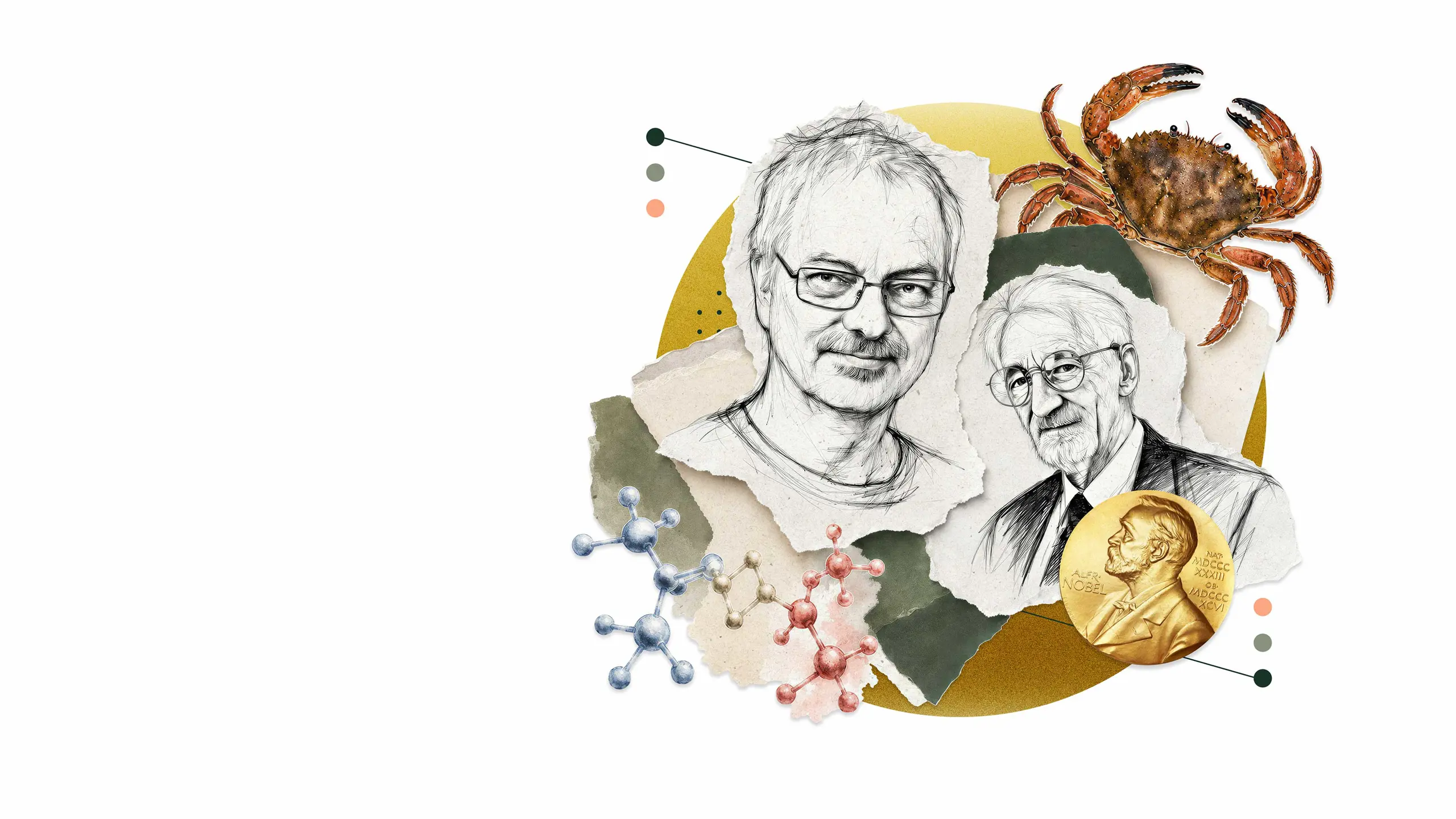
Some of the most significant breakthroughs in chemistry do not involve loud explosions but rather happen quietly, as researchers gradually uncover unseen chemical processes. Twice, these breakthroughs have brought a Danish chemist to Stockholm to receive the Nobel Prize in Chemistry. The first time was in 1997, the second in 2022.
The first prize went to the physiologist Jens Christian Skou (1918–2018) at Aarhus University, in 1997. He was recognised for his discovery of the sodium-potassium pump, a transport protein located in cell membranes that regulates the exchange of sodium and potassium ions between the cell’s interior and its environment.
Explore the book 'From Yeast to Universe'
This chapter is an excerpt from the book 'From Yeast to Universe – Danish Basic Research Supported by the Carlsberg Foundation: 150 Highlights from 150 Years', published by Strandberg Publishing to mark the Carlsberg Foundation’s 150th anniversary. The book offers a kaleidoscopic insight into 150 examples of significant and memorable Danish basic research activities supported by the Carlsberg Foundation over a century and a half. The 150 examples have been selected by 25 Danish researchers.
This discovery built on the Danish physiologist Hans Henriksen Ussing’s (1911–2000) important work during the 1940s on the transport of substances across cell membranes. While Ussing had documented that the transport took place, Skou identified the specific molecular mechanism.
The sodium-potassium pump is essential in any organism with a nervous system. By constantly moving ions in and out of cells, it creates a difference in electrical charge across the cell membrane, which enables nerve cells to transmit impulses inside the brain or to muscles, glands and organs. The difference in electric potential is also used for secondary transport, which brings other essential molecules – such as sugar and amino acids – into the cell.
When Skou presented his findings, during the 1950s and 1960s, the response was widespread scepticism. The idea of a protein that extended through the cell membrane and actively transported ions did not align with current theories.
It took many years of studying more than 20,000 crabs – which have large nerve cells – before the scientific world would accept his results. Today, the sodium-potassium pump is viewed as a mainstay of cellular biology, and knowledge of its function has played a significant role in the development of drugs to treat a range of conditions, including heart disease, hypertension and neurological conditions, such as epilepsy.
Skou’s key insight was that the generation of ion gradients requires energy. He knew that the sodium-potassium pump acts as an enzyme that uses ATP – the cell’s universal energy molecule – to change shape and move ions against their concentration gradient. This established a direct link between transport across cell membranes and the energy metabolism of the cell. This discovery connected physiology, chemistry and biology and fundamentally influenced our understanding of the cell as an active, dynamic system.

Exactly 25 years later, in 2022, the Nobel Prize in Chemistry went to another Danish researcher: the chemist Morten Meldal (b.1954) from the University of Copenhagen, who shared the award with two American scientists for the development of click chemistry. While Skou’s work provided insight into nature’s molecular engines, click chemistry gave science a new, powerful tool for constructing its own molecules.
Click chemistry is a method for joining two molecules quickly, efficiently and with a high degree of precision – almost like clicking two Lego bricks together. Before click chemistry, many chemical syntheses were cumbersome, energy-intense and rife with unwanted by-products.
In the early 2000s, independently of one another, Meldal and the American chemist Karl Barry Sharpless (b.1941) discovered a reaction that changed this: it could take place in water, only required small amounts of copper and was gentle enough to work in biological systems.
Meldal’s work on click chemistry has roots in his time at the Carlsberg Research Laboratory, where he worked with chemical synthesis from 1988 to 2011. Together with a PhD student, he accidentally discovered a reaction that formed stable annular molecules – triazoles – with unprecedented efficiency. News of the discovery quickly spread, and click chemistry became a standard tool in laboratories the world over.
Grant
Grant years: (first and latest) 1969–1984 (Skou), 1988–2011 (Meldal via annual funding of the Carlsberg Research Laboratory) Purpose: Equipment, travel (Skou), laboratory research (Meldal)
The impact of click chemistry extends beyond chemistry. Today, the method is used in the development of drugs, vaccines, diagnostics, materials research and cellular biology.
One major area is the development of antibody-drug conjugates, where an antibody transports a powerful targeted drug that is not activated until it reaches a cancer cell, for example. This use was developed further by the third Nobel Prize recipient in 2022, the American chemist Carolyn Bertozzi (b.1966).
The key property of click chemistry is not just the efficiency of the reaction but also its resilience. The reaction almost always works, no matter which molecules are joined together, and does not disturb other chemical processes. The discovery has given chemists a universal tool to construct complex structures step by step. Click chemistry has made chemical synthesis faster, more reliable and much easier to apply outside the chemistry lab.
Together, the two Danish Nobel Prizes in Chemistry tell a larger story of chemistry as a source of both insight and method. From Skou’s discovery of life’s fundamental ion flows to Meldal’s elegant methods for building new molecules, they illustrate how patient basic research can change our understanding of life – and provide us with new ways of intervening in it.
The chapter is written by Kristian Sjøgren.

